Showing posts with label robotic. Show all posts

Wednesday, November 30, 2011

Flight Assembled Architecture - Gramazio & Kohler et Raffaello D'Andrea

"Die Professur Gramazio & Kohler, Architektur und Digitale Fabrikation lädt herzlich zur Ausstellung "Flight Assembled Architecture" am FRAC Centre Orléans ein. Gemeinsam mit Raffaello D'Andrea entwickelt, wird eine spektakuläre
Installation zu sehen sein, die vor den Augen des Besuchers "fliegend" assembliert wird und die langjährige Forschung der Kooperationspartner in Form eines visionären Architekturprojekts kulminieren lässt."

[via www.dezeen.com]


Thursday, October 13, 2011

adapa - adapting architecture


"ADAPA is a cross disciplinary company where the focus is on adapting technology and materials that have untapped potentials into an architectural context.

We are a small research based architectural practice, where we use research both to reposition ourselves and simultaneously to create projects that give us a completely different approach than other architectural firms.

We believe that the ability to design free, affordable and sustainable lies in the ability to understand and make full use of the latest technologies and production methods and introduce them as the basis for modern architecture."
Robots in Architecture


"The international Association for Robots in Architecture is originally a spin off association of Vienna University of Technology. Its goal is to make industrial robots accessible for the creative industry, artists, designers and architects, by sharing ideas, research results and technological developments.

Founded in December 2010 by Sigrid Brell-Cokcan and Johannes Braumann, robots in architecture is an open platform for everybody interested in the creative use of and innovative fabrication with industrial robots.

Robots in Architecture is engaged in applied research, soft- and hardware development, “robot pedagogics” – and in the question: how soon will robots revolutionize architecture?

We pursue the association’s goal by offering workshops and holding lectures at international conferences, schools, and universities, and by maintaining the Robots in Architecture homepage, which serves as a hub for all things robotic in architecture, art, and design."


D-Shape


"The 21st century revolution in building technology has a name. D-Shape.
The mega scale free-form printer of buildings.
What couldn't be done, now can be done."


"D-Shape is a new robotic building system using new materials to create superior stone-like structures.

This new machinery enables full-size sandstone buildings to be made without human intervention, using a stereolithography 3-D printing process that requires only sand and our special inorganic binder to operate. D-Shape is a new building technology which will revolutionize the way architectural design is planned, and building constructions are executed. By simply pressing the “enter” key on the keypad we intend to give the architect the possibility to make buildings directly, without intermediaries who can add interpretation and realization mistakes."

Friday, April 2, 2010

Formtexx- freeform facades with automotive precision


Formtexx has launched its unique double-curvature facades at The Building Centre. These facades are manufactured using the technology and precision of automotive mass production.

The launch of this innovative process shows that the digital design and manufacture of complex geometry sheet metal work is now a seamless reality. It´s not rapid prototyping – it is rapid manufacturing on an industrial scale. Formtexx has developed an entirely new category of sheet metal processing which produces custom double curvature components to the finish quality and precision of the high end automotive industry. It does this robotically, without fixed tooling, and in the quantities anticipated by major construction projects.

Thursday, April 1, 2010

Digital Tectonics: Robotic Fabrication


This is the course blog for Digital Tectonics >> Robotic Fabrication taught within the School of Architecture at Carnegie Mellon University by Jeremy Ficca.

Thursday, October 15, 2009

hyposurface


"HypoSurface is the World's first display system where the screen surface physically moves! Information and form are linked to give a radical new media technology: an info-form device.

The surface behaves like a precisely controlled liquid: waves, patterns, logos, even text emerge and fade continually within its dynamic surface. The human eye is drawn to physical movement, and this gives HypoSurface a basic advantage over other display systems.

As a digital device, any input (sound, movement, an Internet feed...) can be linked to any output (logos, patterns, text...) This offers full interactivity with an audience, and a simple User Interface allows HypoSurface to be 'tuned' to any event, its wide range of effects choreographed easily (by you…)"

Friday, March 20, 2009

Geometry in Architecture - Design Studio Fall 2008


From classical Greece to the medieval Gothic and Orient, Kepler to the Crystallographers to Coxeter, the language and knowledge of geometry has grown and developed giving a view into a fabulous world of pure order.

The expression of these ideal forms in the world as structure and ornament and ideally a synergy of the two has and continues to be an activity of architecture when it strives to transcend utilitarian purposes. Explorations included research, hand drawing, model making and computer drafting and modeling.

Tools developed and utilized to serve the expression and fabrication of geometric compositions included rhinoscripts, grasshopper definitions and CNC 3-axis mills and laser cutters.

Sunday, October 19, 2008

rethinkarchitecture.


Juergen Weiss, Architect, is the founder of ReThink Architecture, a design studio and collaborative research forum engaging the field of architecture via different approches. Starting from scripting to digital fabrication until material research. He graduated with a Diplom of Architecture form the University of applied science Biberach (Germany)and a second Graduation of the Institut d'Arquitectura Avançada de Catalunya (IAAC, Barcelona)with a Master of Advanced Architecture. Juergen’s work experience in Germany, Swiss and Spain includes different offices, where he was the project architect, from competition to construction of different projects. During this time he got different insight of material research and computation design.

Wednesday, July 16, 2008

robotic ecologies lab

Blog:
"lab, seminar and workshop blog with posts by jason k. johnson exploring promiscuous new ecologies brought forth by the rapid release of advanced computation into the physical realm"


image:
The 2008 Digitalis Robot was produced by architecture Prof. Jason Johnson and music Prof. Matthew Burtner with assistance from Joy Wang, Megan Manion and Troy Rogers -- plus the Interactive Media Research Group [IMRG] and ITC at UVa.

Sunday, July 13, 2008

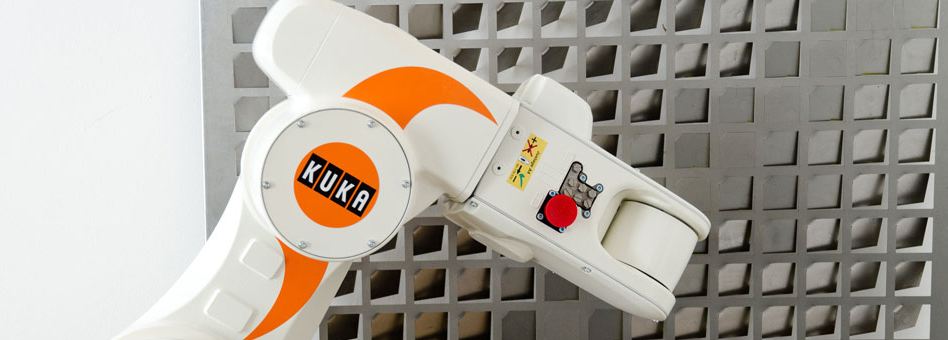
numerical methods of manufacturing with the kuka robot

in spring this year i ´ve got a deep insight in working with the kuka-robot and the software "hypermill" within the course "numerical methods of manufacturing".

http://tuwis.tuwien.ac.at/lva/272087
http://e2642.kunst.tuwien.ac.at/

i thought that it could be very interesting to try to mill a part of a triply periodic surface and so i took a code for k3dsurf http://k3dsurf.sourceforge.net/ from Ruggero Gabbrielli (Centre for Orthopaedic Biomechanics - Department of Mechanical Engineering - University of Bath) and
tried to use that to show the repeating properties from that kind minimal surface.
http://www.msri.org/about/sgp/jim/geom/level/skeletal/index.html

further it would be very interesting to research the properties from these skeletal graphs and their use for experimental space grids.