
Blog of the "Diploma Studio 10 at Westminster University School of Architecture and the Built Environment"
Ressources, inspiration , tutorials, ... and more.


Made exclusively from polypropylene pipe and nylon cable ties, this installation occupied an entire room at Industry Gallery, in Washington DC from September to November 2011.
The work partly pays homage to Washington DC's own iconic cherry trees, whilst also questioning our relationship with and attitudes towards plastics.
The longevity and ready availability of the industrially manufactured materials used to construct the installation stands in stark contrast to the ephemerality and natural beauty of the cherry trees and blossoms it emulates."
[via www.dezeen.com]


We are a small research based architectural practice, where we use research both to reposition ourselves and simultaneously to create projects that give us a completely different approach than other architectural firms.
We believe that the ability to design free, affordable and sustainable lies in the ability to understand and make full use of the latest technologies and production methods and introduce them as the basis for modern architecture."
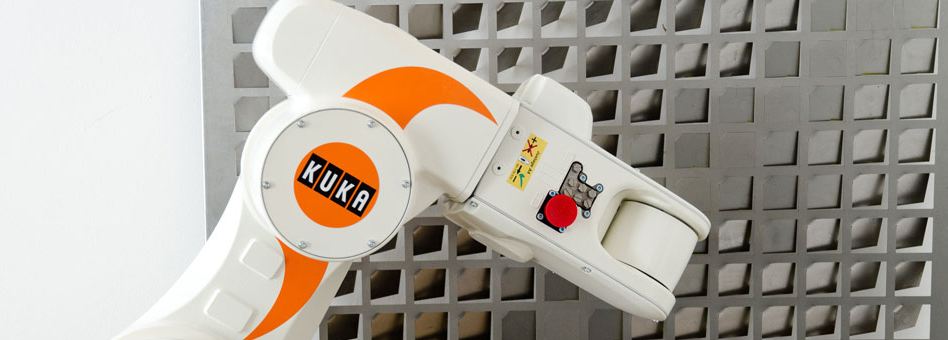

Founded in December 2010 by Sigrid Brell-Cokcan and Johannes Braumann, robots in architecture is an open platform for everybody interested in the creative use of and innovative fabrication with industrial robots.
Robots in Architecture is engaged in applied research, soft- and hardware development, “robot pedagogics” – and in the question: how soon will robots revolutionize architecture?
We pursue the association’s goal by offering workshops and holding lectures at international conferences, schools, and universities, and by maintaining the Robots in Architecture homepage, which serves as a hub for all things robotic in architecture, art, and design."

"The 21st century revolution in building technology has a name. D-Shape.
The mega scale free-form printer of buildings.
What couldn't be done, now can be done."
"D-Shape is a new robotic building system using new materials to create superior stone-like structures.
This new machinery enables full-size sandstone buildings to be made without human intervention, using a stereolithography 3-D printing process that requires only sand and our special inorganic binder to operate. D-Shape is a new building technology which will revolutionize the way architectural design is planned, and building constructions are executed. By simply pressing the “enter” key on the keypad we intend to give the architect the possibility to make buildings directly, without intermediaries who can add interpretation and realization mistakes."

"Material Intensities
Imagine the design space of architecture was no longer at the scale of rooms, walls and atria, but that of cells, grains and vapour droplets. Rather than the flow of people, services, or construction schedules, the focus becomes the flow of light, vapour, molecular vibrations and growth schedules: design from the inside out.
The sg2012 challenge, Material Intensities, is intended to dissolve our notion of the built environment as inert constructions enclosing physically sealed spaces. Spaces and boundaries are abundant with vibration, fluctuating intensities, shifting gradients and flows. The materials that define them are in a continual state of becoming: a dance of energy and information."


"Liquidmetal® alloys are a revolutionary class of materials that redefines performance and cost paradigms. The superior properties of Liquidmetal alloys are made possible by revolutionary scientific and technological innovations. Liquidmetal alloys represent the first enabling materials technology since the creation of thermoplastics and possess characteristics that make them superior in many ways to other commercially-viable materials. First, they have an "amorphous" atomic structure, which is unprecedented for structural metals. Second, they include a multi-component chemical composition, which can be optimized for various properties and processes. Finally, they lend themselves to process technology similar to that possessed by plastics."


Formtexx has launched its unique double-curvature facades at The Building Centre. These facades are manufactured using the technology and precision of automotive mass production.
The launch of this innovative process shows that the digital design and manufacture of complex geometry sheet metal work is now a seamless reality. It´s not rapid prototyping – it is rapid manufacturing on an industrial scale. Formtexx has developed an entirely new category of sheet metal processing which produces custom double curvature components to the finish quality and precision of the high end automotive industry. It does this robotically, without fixed tooling, and in the quantities anticipated by major construction projects.


Mode is a design office that leverages computational expertise through design research, teaching, and consulting.
Mode utilizes diverse methodologies including code, associative and relational strategies, as well as digital fabrication in the production of material organizations and the formation of space.
While we are interested in intense iterative design processes, we believe the evolution and contextualization of these procedures in a broader social and cultural domain is both our primary objective and the means for embedding interest and significance into design.
Mode is Ronnie Parsons and Gil Akos.
This repository serves as an index of the research and teaching currently underway at The Stevens Institute of Technology’s Product Architecture Lab.
While we are interested in iterative design processes, we believe the evolution and contextualization of these procedures within the broader ecology of the built world is both our primary objective and the means of embedding interest and significance into design.


