
Blog of the "Diploma Studio 10 at Westminster University School of Architecture and the Built Environment"
Ressources, inspiration , tutorials, ... and more.


Using Yeti you can build a parametric model through code and see changes instantly.
Yeti is still a work in progress and only offers a very basic geometry library at the moment, but you can improve it by contributing to the C# codebase over at bitbucket.
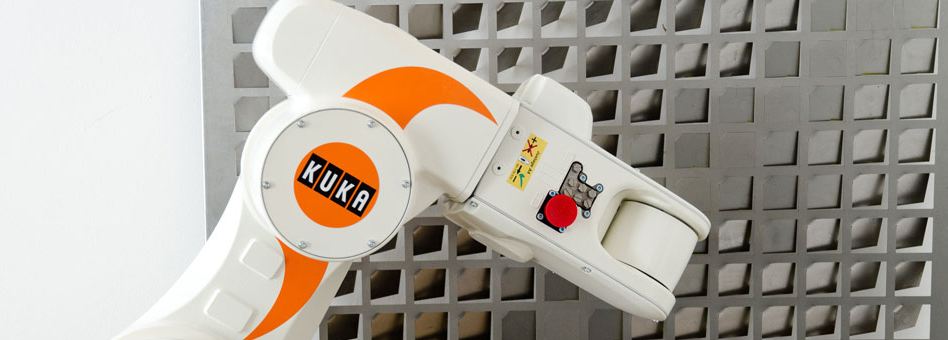

Founded in December 2010 by Sigrid Brell-Cokcan and Johannes Braumann, robots in architecture is an open platform for everybody interested in the creative use of and innovative fabrication with industrial robots.
Robots in Architecture is engaged in applied research, soft- and hardware development, “robot pedagogics” – and in the question: how soon will robots revolutionize architecture?
We pursue the association’s goal by offering workshops and holding lectures at international conferences, schools, and universities, and by maintaining the Robots in Architecture homepage, which serves as a hub for all things robotic in architecture, art, and design."


"In eQUILIBRIUM, the design and analysis of structures are taught through interactive, graphic statics-based drawings created with GeoGebra rather than text and equations.
Graphic statics is a powerful method for the design and analysis of structures that, by using force polygons and simple geometric construction techniques, provides intuitive visual information about the relation between form and forces in a structural system."
RhinoVAULT - designing funicular form in Rhino
http://www.block.arch.ethz.ch/tools


"A new release of PanelingTools plugin is now available for Rhino 5.0 Beta.
You can find download links and documentation at PanelingTools download
page.

New in this release:

Added mesh module support to paneling variable custom 3D components. It is
now possible to select a list of mesh modules or two meshes and calculate
mean modules.
Fixed a bad geometry bug when paneling surfaces with singularity.
Added support to generate mean curves with local bounding space.
Added the ability to define bounding space when creating variable mean
surfaces.
Added support for local bounding space for 3d variable modeling.
Added support to create notches in ptFinEdges and ptExtrudeEdges commands.
Fixed labeling objects UI bug.
Fixed crash bug when creating singular panels.
Fixed a bug related to applying variable patterns to diamond grids.
Added ptTriangulateFaces command.
Added GetPanelingGrid function to scripting to capture a paneling grid and
turn into two dimensional array of points."


If you are looking membrane design or to create digital models of tensile structures you've found the right spot. Use our online tools and just contact us for additional information. We can support you for many questions along the process of membrane structure design."


Mode is a design office that leverages computational expertise through design research, teaching, and consulting.
Mode utilizes diverse methodologies including code, associative and relational strategies, as well as digital fabrication in the production of material organizations and the formation of space.
While we are interested in intense iterative design processes, we believe the evolution and contextualization of these procedures in a broader social and cultural domain is both our primary objective and the means for embedding interest and significance into design.
Mode is Ronnie Parsons and Gil Akos.


| Organic surfacing for design |  |  |


This repository serves as an index of the research and teaching currently underway at The Stevens Institute of Technology’s Product Architecture Lab.
While we are interested in iterative design processes, we believe the evolution and contextualization of these procedures within the broader ecology of the built world is both our primary objective and the means of embedding interest and significance into design.


